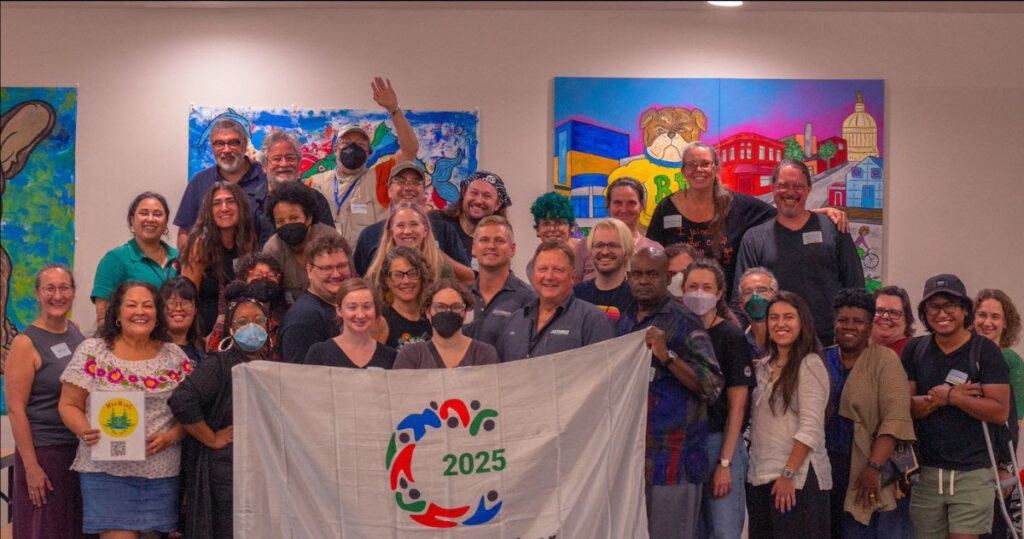
“What is it that traditional companies withhold from each other, that we don’t have to?” This question, posed by Andy Bowling from comp.coop, was answered by a resounding chorus at the 2025 MadWorC Regional Rendezvous.
Over two days in September, USFWC Co-op Clinic Training Manager Maureen Darras attended the MadWorC Regional Rendezvous in Madison, WI and shares her reflections to amplify these lessons from the Midwest, across the country:
MadWorC has long been an innovator. In 2023, they taught their co-op academy, a unique model designed for trade school students, through the Continuing & Professional Education department of Madison College. In 2024, they made their curriculum available for free download. While MadWorC’s mission is to support and build the solidarity economy in Madison, WI, since 2020 they have been extending the invitation for peer-to-peer learning and cooperation among coops to the greater Midwest through the Regional Rendezvous.
The Rendezvous demonstrated how regional associations and federations can realize the potential of Education, Training, and Information (Cooperative Principle 5) and Cooperation Among Cooperatives (Cooperative Principle 6) through the cross-cooperative, cross-industry exchange of lessons and tested solutions, making worker-owned businesses and their communities stronger. This event focuses on practical, action-oriented assessments cooperatives have done and the strategies they’ve developed. This year, we learned about how cooperatives in the Midwest are addressing climate crisis, protecting worker-owned coops from the “enshittification” of tech and the predatory nature of venture capital, seizing the means of production by converting businesses to worker-ownership, and perhaps the most impressive: running effective committee meetings.
In addition to attending the sessions and presenting a session, I was able to tour 2 different worker-owned businesses: Union Cab Cooperative (worker-owned since 1979!) and Isthmus Engineering & Manufacturing (their company started in 1980, and became a worker-owned cooperative in 1982).
Union Cab Cooperative was formed by ex-Checker cab workers who went on strike, and then pivoted to create their own taxi company to better control their labor conditions. There are still 2 drivers working there who have been around since their first year in operation. You can read more about their incredible history here.
After landing at the Madison airport, I rode a Union Cab to my hotel, and asked the driver “Why don’t you work for Uber or Lyft?” He responded, “Because I grew up here, and I’d rather work for a local company than line the pockets of some fat cats in Silicon Valley.” Taking a Union Cab to tour their facility two days later, I asked another driver, “Did you know it was a coop when you joined?” Without skipping a beat, she said: “That’s the only reason I joined!”
Between the pride flags hanging in the mechanics bay, the signs for democracy classes, and the job descriptions pinned to the walls (all openings are posted internally first), their ownership culture is visible everywhere.
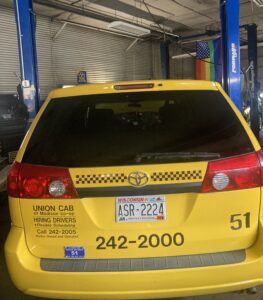

As I gazed out at their fleet of mostly used Priuses, I reflected on Esther West’s session “Regional Climate Justice Planning” from the day before, which had highlighted ways that worker-owned cooperatives are not just approaching adaptation (dealing with the impacts of climate change), but becoming leaders in mitigation (reducing & preventing climate change). Union Cab can get 300,000-500,000 miles out of these used cars. Union Cab also installed rain gardens and solar panels on their property as climate mitigation measures.
The fleet includes 6 Accessible Transportation Service (ATS) vehicles as well – those are all new, because their cooperative partnered with the city of Madison and Dane County to create a non-profit to get federal grants to buy the vehicles. Union Cab is the only cab company in WI that offers 24 hr/day wheelchair accessibility.
I continued to think about disability justice and the ways cooperatives provide community care in an increasingly for-profit, anti-person world of privatized healthcare as we learned from PJ Chamberlain about Community Pharmacy, a worker-owned cooperative that grew out of a volunteer-staffed pharmacy. They’re celebrating 53 years in business providing a full continuum of health care options and philosophies, including: free prescription delivery, harm reduction strategies such as free clean needle kits, free condoms and lube, Plan B, pregnancy tests and syphilis tests, and an extensive reference library of printed resources/zines that customers can use, as well as Chinese patent medicines. As a worker-owned cooperative, they can set their prices themselves for customers who don’t have insurance or have a high copay. They also have a copay pay it forward fund, and MadWorc supports a $100/year account customers can use.
Community Pharmacy chose GroupHealth Cooperative (GHC), a non-profit, member-owned health plan, as an insurance provider because they’re a long-standing cooperative.
You can support the GHC care providers who have been fighting for a union since December 2024 by sending an email to the GHC Board asking them to respect the will of the membership and recognize the union.
During a session in which Ole Olson, a retiring worker-owner from Isthmus Engineering, presented their committee structure, Dave Abbott, Vice President & worker-owner of Terra Firma in Minneapolis, MN, shared that their committee charter was based on this design from Isthmus. PJ Chamberlain of Community Pharmacy chimed in to say their cooperative had also seen this presentation before and learned from it too, especially benefiting from the concept of the Vice President being accountable for follow-through.
💡If your cooperative has been struggling with follow through or becoming more efficient while retaining democracy, I encourage you to contact Isthmus Engineering to learn more about their committee structure!
🧰You can download our newest Co-op Clinic mini guide on member engagement for free here.
Later in the day, Ole Olson also hosted a panel discussion: “Cooperative Veterinary Care – a conversion”, in which he interviewed John Dally (the selling owner of Cooperative Veterinary Care), Kristin Forde (their technical assistance provider from UW Center for Cooperatives), and Courtney, a former employee who is now a worker-owner of the business.
In the veterinary industry, conversions are a uniquely powerful intervention to address crises. Veterinary professionals are at high risk of dying by suicide, due to a variety of occupational stressors, including burnout. Private equity buyouts of veterinary practices are only making those conditions worse. Upon converting to a cooperative, Cooperative Veterinary Care became not only more competitive, but more compassionate, and could attract workers escaping corporate practices.
In addition to the willingness of owners to sell, the capacity of technical assistance providers to support the conversion, the existence of lenders to finance the sale, and the popularization of the model through panels like this, there are potential legislative policies that could further incentivize conversions. For example, the Wisconsin legislature is considering legislation that would offer businesses that transition to worker-owner cooperatives a nonrefundable income tax credit amounting to 70% of conversion costs.
Across industries and across the country, conversions exist as a strategy to transfer ownership and decision-making to workers on a mass scale, keep locally owned businesses open, and create businesses that are better positioned to address conflict and meet this political moment. In the words of Dr. John Dally, who sold his business to his employees: “There’s a threat to democracy. This is democracy at its lowest level, at the place you spend most of your time. It fills a need socially, and politically.”
We later learned about the needs that public housing address, socially and politically, via the presentation on the cooperative history of Glendale Townhomes from Kaaha Kahiye, a public housing organizer: “Built in 1952, Glendale is the oldest remaining Section 9 public housing, and the only community of its kind left for families. The rest have been demolished.”
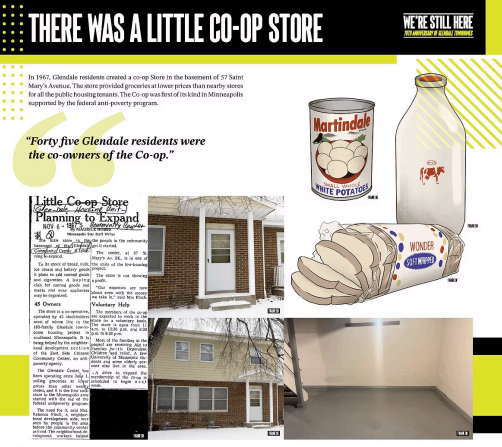
Slide from Kaaha Kahiye’s presentation, “Glendale, Public Housing & Cooperative Organizing: a shared legacy”
In 1967, Glendale residents opened a co-op store in the basement, run by 45 owners and volunteers. In 1970, they coordinated with the Black Panther Party’s Free Breakfast Program, to open a free breakfast and lunch program in 1970.
Glendale Townhomes currently houses some of Minneapolis’ poorest people: families, disabled folk, seniors, and lots of Black People (77% of public housing residents in Minneapolis are Black). It is facing the threat of demolition. Defend Glendale & Public Housing Coalition is a grassroots, resident-led campaign to prevent the demolition of Glendale Townhomes & the ending of Section 9 Public Housing in Minneapolis.
What sets cooperatives apart is cooperation: we have stronger businesses and stronger communities because we cooperate, rather than compete. Not only are worker coops more powerful together than they are in isolation, but they are more powerful when they take the time to invest in Cooperative Principle 5 (Education, training, and information) through in-person tours, peer-to-peer exchanges, the recentering of Black cooperative history, and the continual practice of tool and template sharing.
In coming together (Cooperative Principle 6) we redefine power, and learn how to apply that power to defend our communities and invest in our potential.
I encourage cooperative ecosystems across the country to adapt these lessons from the Midwest and strengthen the health and safety of your communities at home! MadWorc exemplifies the power of place-based organizing to build relationships across communities via shared values, frameworks, and strategies. If you’ve learned from this blog post, donate to MadWorC directly!
Help strengthen cooperation and collaboration among cooperatives nationwide:
- Join and participate in your regional and national worker co-op federations – become a member of the US Federation of Worker Cooperatives here
- If you are already a member of a regional network, join the USFWC’s Co-op Ecosystems Peer Network to exchange lessons with other organizers building thriving local worker co-op ecosystems.