This July, USFWC Co-op Clinic Training Manager Maureen Darras went on a 3,000 mile road trip to visit cooperatives and recounts what she learned!
As I drove from New Mexico to Oklahoma, I thought about immigration policy, MAGA, Jesus Christ, and fentanyl. You would too, if you were reading the billboards that break up the landscape of oil and gas fields, large scale cattle operations and corn, and gigantic white crosses. I was on a road trip to meet with worker-owners in Oklahoma, Arkansas, Missouri, and Ohio, to see how the USFWC could better serve the south central/lower midwest. I was curious to learn how cooperative ecosystem organizing happens in states with few to no cooperative developers, cooperative development centers, or cooperative loan funds, and historically little engagement from the USFWC.
My first stop was Flora Bodega, a worker-owned co-operative & Food Hub in Oklahoma City. Across from tables laden with locally grown okra, onions, and black walnuts, I was impressed by the shelves of community art for sale, the Free Art Closet, and the vinyl and CDs from local bands.
Angela Chase, worker-owner and founder of Flora Bodega, told me about Worm Parade, the new event space they’re opening up next door, and the FREEDGE (a full fridge located just outside the store that is open 24/7 for anyone to drop off or take food as needed.)
Unlike many consumer-owned coops, with aisles of General Mills-owned products and a small inventory of locally made/grown goods, Flora is a symphony of Oklahoma City, played by an orchestra of local farmers, bakers, musicians, veterans, and activists.
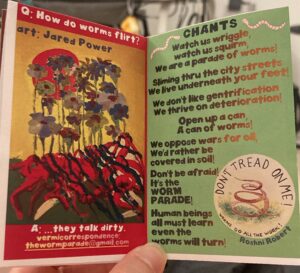
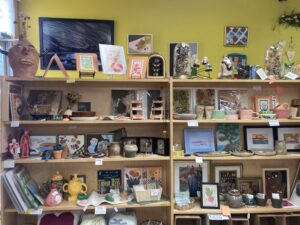
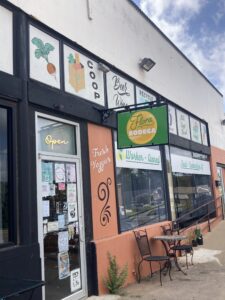
A zine about the Worm Parade, shelves of mixed-media artworks and the storefront of Flora Bodega.
With a Compost Adjacent CD in hand, Angela sent me on my way to CommonWealth Urban Farms down the road. I got lost and never made it there – I’m terrible at following directions – but CommonWealth would come up again and again throughout my time in OK.
Fertile Ground, a worker-owned composting and recycling facility, has been a member of the USFWC for 10 years, and a cooperative for 14 years. After attending trainings by Will Allen of Growing Power and Bob Waldrop of the Oklahoma Worker Cooperative Network, Terry Craghead recruited fellow CommonWealth volunteers Matt Zitterkob and Kara Joy McKee to found Fertile Ground. Familiar with Will Allen but not with Bob Waldrop, I looked him up. It was clear from the opening line of Bob’s obituary that he was a legendary figure in Oklahoma City: “Bob was buried in his overalls.”
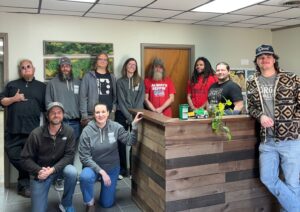
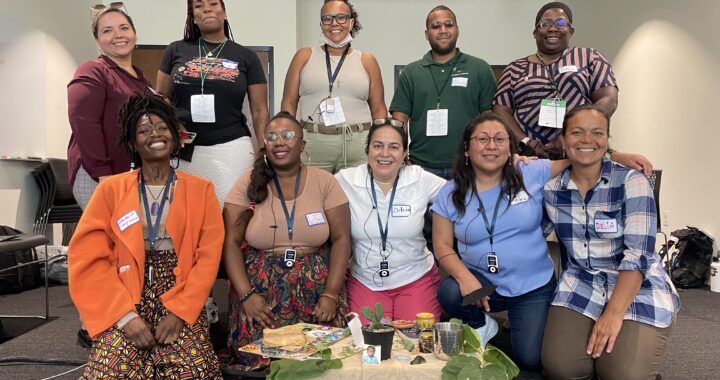
Worker-owners of Fertile Ground Cooperative.
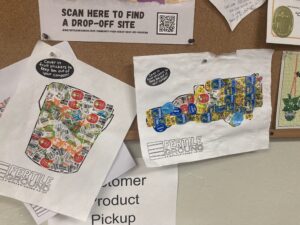
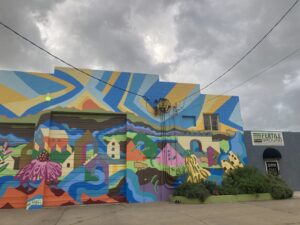
A wall of pages to place stickers from fruits and vegetables to help remove micro-plastics from the waste stream & compost processing, and a mural painted by a worker-owner outside of the Fertile Ground Cooperative.
A major strength of Fertile Ground is their ability to diversify their business model, which can be seen in the inputs they gather for compost production, ranging from green waste from local cannabis farms to the “zoo poo” from herbivores at the Oklahoma City Zoo. In addition to being recession-proof – elephants will create waste irrespective of the economy – benefits of this coop-zoo partnership circulate back to the community: all customers who sign up for residential compost pick up receive 1 free zoo pass for every 20 lbs of compost their home generates!
The next morning, I joined YardFarm Co-op in Norman to help with their pre-full-time-gigs harvest at the invitation of Steve Lett, one of the co-founders of YardFarm and employee-turned-worker-owner at Fertile Ground. YardFarm was founded earlier this year as a project of Solidarity Norman, a nascent solidarity economy ecosystem organization for the area. As YardFarm broke ground, Solidarity Norman organized a compost distribution event with Red Dirt Collective and Fertile Ground to drop a couple yards of zoo poo compost at each of the community gardens in Norman, with the remainder dropped for YardFarm’s new beds. Once again, many inputs to create healthy cooperative soil quite literally bear fruit.
When I first met Steve in a free Co-op Clinic intake, the project was going by “Farmyard Cooperative,” so I inquired about the change. Steve shared that while the coop’s production was centered in worker-owner Ashley’s yard, they quickly realized half of the worker-owners also had gardens at home, and began to contribute their own produce (to receive patronage for the “produce hours”). The name change emphasizes that this model can be replicable across yard-farms in Norman.
As the YardFarm crew headed to their day jobs, I made my way to Gray Owl Coffee, a coffee shop which converted to become Norman’s first worker-owned cooperative. I learned that Gray Owl Coffee composts through Fertile Ground too, and that they co-facilitated a co-op education panel on May Day with Fertile Ground & All Rise!
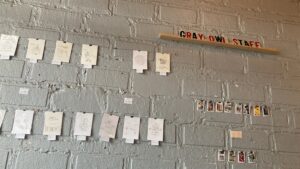
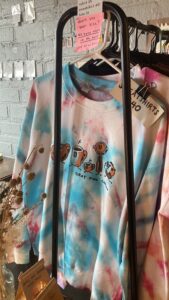
Gray Owl Coffee staff art wall and merchandise design & created by worker-owners at the coffee shop in Norman, OK.
At the Movimento dos Trabalhadores Rurais Sem Terra (Landless Workers’ Movement) Escola Nacional Florestan Fernandes in Brazil, I learned that the social function of agriculture is to produce the necessary energy for beings to survive, and the creation of cooperative agribusinesses is necessary to ensure that the production results in quality food, avoids the use of preservatives + agrotoxins, and grows on a scale compatible with the community. Outside of Brazil, I had never seen this in practice…until Oklahoma.
That evening, thanks to a very effective phone tree, Oklahoma’s cooperators gathered at Opolis, a worker-owned music venue that the former owner sold to the musicians who had been working the bar/door when it wasn’t their show. Lane, one of the former employees who purchased the company, explained that the only reason part time musicians were able to afford the venue is because they ran a successful Kickstarter in Norman. More simply put, he said, “the only reason we’re doing this is because the community wants us here.”
Every coop ecosystem I visit reveals an additional reason why conversions to worker-ownership strengthen the local economy. In Wisconsin, I learned about how conversions are improving job quality in the veterinary industry. In Oklahoma, I was seeing crowdfunding for conversions as a radical example of communities ‘voting with their dollars’ for what businesses they wanted in their town.
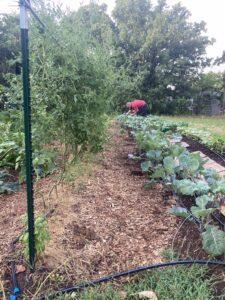
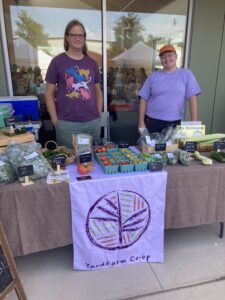
YardFarm worker-owners harvesting and selling their produce at the Norman Farm Market.
Munching on an Armenian cucumber, I set off for Arkansas. Fertile Ground founder Terry’s words came to mind: “The dynamics that drive our economy are too large. Cooperatives are the only form of action that does anything of value here.” It wasn’t hard to feel the weight of land consolidation, MAGA Republican politics, and climate change as the outside temperature on my dash read 107 degrees and my car’s alternator failed.
While I waited for the mechanic, I wondered if the socialists of the 1917 Green Corn Rebellion in Oklahoma and founders of Commonwealth College in Arkansas would be proud, or disappointed, to know we’re still organizing against exploitation and extraction, and still building a post-capitalist cooperative future.
In contrast to Norman, OK, where looking out the window of Gray Owl Coffee you can see Opolis across the street, the worker-owners I met in Conway were isolated. Weird & Well Counseling is currently the only worker-owned cooperative in Arkansas.
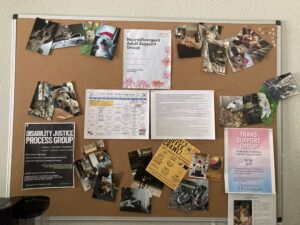
A community board at Weird & Well Counseling cooperative.
Fortunately, they’re not alone, at least not online. A few months ago, I reached out to all of the worker-owned therapy practices I knew of in the country to launch a USFWC Peer Network, and asked coop developers in our membership for leads. I was contacted by developer members letting me know about half a dozen more therapy cooperatives that had recently converted with their support. This Peer Network has been meeting virtually for months, troubleshooting their shared questions around telehealth, unionizing, administrative structures, compensation, licensing, and more.
We talked about the impact of the USFWC’s support on their development, and how in the future they would be the cooperative I’d be sending other start-ups in Arkansas to for guidance. “Maybe the national conference will be in Arkansas one day,” we joked.